
Does Glutathione Really Lighten Skin? What the Research Actually Shows

A clear, evidence-based look at oral, topical, and IV glutathione for skin lightening — what works, what doesn’t, and what to watch out for.
Quick answer: A 2025 medical review found that oral and topical glutathione can produce measurable, but variable, skin-lightening effects with relatively few side effects. Intravenous (IV) glutathione may produce more rapid effects but carries real safety risks, including anaphylaxis and liver damage, and there’s still no standardized, medically agreed-upon dosing for any form. Those risks aren’t theoretical:
in August 2026, the FDA reported adverse events in at least 30 patients following IV glutathione, with some cases resulting in hospitalization. The FDA also warned that dietary-supplement-grade glutathione is not appropriate for making injectable drugs and reported recalls involving elevated endotoxin levels.Glutathione skin lightening has been studied for its potential effects on melanin and skin pigmentation, but the results vary by form and person.
Table of Contents
- What Is Glutathione, and Why Is It Linked to Skin Lightening?
- How Does Glutathione Lighten Skin?
- Oral Glutathione: Does It Work?
- Topical Glutathione: What the Evidence Shows
- IV Glutathione: Why Experts Urge Caution
- Oral vs. Topical vs. IV: A Side-by-Side Comparison
- Who Should Be Especially Cautious?
- What Beginners Should Know Before Trying It
- Frequently Asked Questions
- Final Takeaway
Glutathione Skin Lightening: What Does the Research Show?
Glutathione is a small tripeptide made from three amino acids, produced naturally by the body. It’s best known as one of the body’s main antioxidants, helping protect cells from oxidative stress. Over the past decade, it has also become popular as a skin-lightening ingredient, sold as oral supplements, topical creams and soaps, and IV infusions marketed at aesthetic clinics.
According to a 2025 narrative review published in the peer-reviewed journal Cureus, the rising consumer demand for skin-lightening products has pushed glutathione into the spotlight as a “potentially safer alternative to conventional agents.” That review is the main evidence base for this article, and it’s worth understanding what it actually found — not just what marketing claims suggest.
How Does Glutathione Lighten Skin?
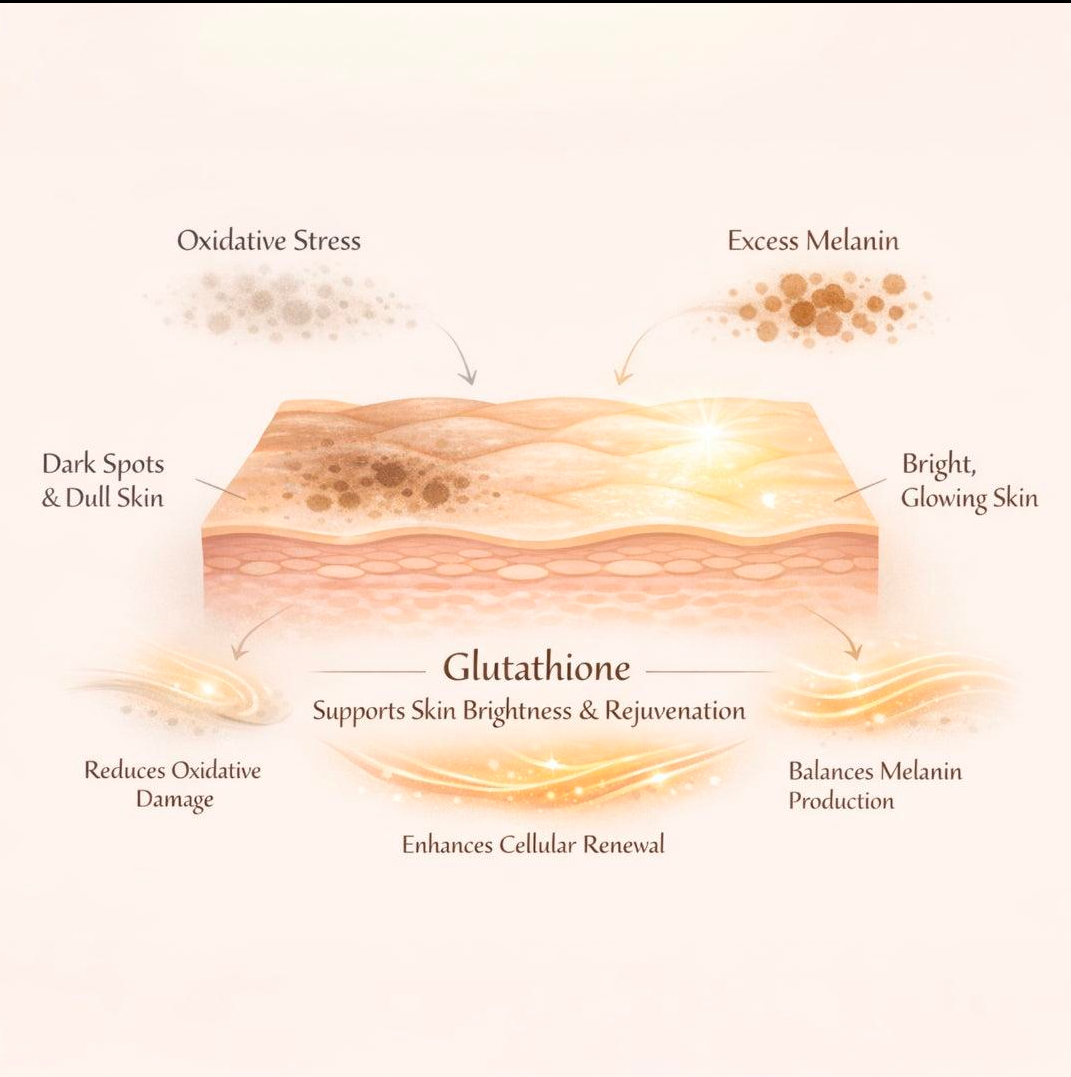
The leading theory is that glutathione interferes with melanogenesis, the process by which skin cells produce melanin (the pigment responsible for skin color). It’s thought to do two things:
- Inhibit tyrosinase, the key enzyme that drives melanin production.
- Shift pigment type, encouraging the body to produce more of the lighter pheomelanin rather than the darker eumelanin.
Importantly, the 2025 review notes that the exact mechanism is still not fully mapped out. Researchers understand the broad strokes, but the precise molecular pathways connecting glutathione levels to visible changes in skin tone remain an active area of study.
Oral Glutathione: Does It Work?
Of the three delivery methods, oral glutathione has the most research behind it and, per the review, showed “significant but variable decreases in melanin levels with limited side effects.” In plain terms: it can work, but results differ a lot from person to person. Overall, oral and topical routes have generally shown fewer and milder reported adverse effects than IV administration.
Research on glutathione skin lightening has mainly examined changes in melanin and skin pigmentation over time.
This lines up with earlier clinical research. A randomized, double-blind, placebo-controlled trial by Arjinpathana and Asawanonda, published in the Journal of Dermatological Treatment (2012), tested oral glutathione as a whitening agent and reported measurable effects on skin tone in healthy volunteers over several weeks.
A 2019 systematic review in the Journal of Cosmetic Dermatology (Dilokthornsakul et al.) looked across multiple glutathione studies and reached a similar conclusion: generally positive effects on skin color, tempered by small sample sizes and inconsistent study design.
Common mistake to avoid: Assuming a supplement label’s claims match clinical dosing used in research. Products vary widely in glutathione form and concentration, and the review found no standardized, agreed-upon dosing protocol — which is exactly why results are so inconsistent between users.
Topical Glutathione: What the Evidence Shows
Topical formulations (creams, serums, soaps) were found to provide “good-level melanin reduction and skin texture improvement” in the studies reviewed — but with “varying sustainability,” meaning the effects don’t always hold up over time once use stops or slows.
One practical issue with topical glutathione is absorption: glutathione is a relatively large, fragile molecule, and getting enough of it through the skin barrier to affect melanin production is harder than it sounds.
Some newer formulations pair it with penetration enhancers or use esterified derivatives (chemically modified forms) to improve delivery — an area the review flags as promising but still early-stage, since some of these derivatives have shown cell toxicity in lab (in vitro) studies and haven’t been tested extensively in humans.
IV Glutathione: Why Experts Urge Caution
This is the part most marketing leaves out. In August 2026, the FDA reported adverse events in at least 30 patients following IV glutathione and said some cases resulted in hospitalization. The FDA linked the concern to glutathione labeled as dietary-supplement grade that was used to compound injectable products, and it reported recalls involving elevated endotoxin levels.
Beyond that specific contamination event, the underlying research picture is also cautious.
The 2025 Cureus review states plainly that IV glutathione, “although having rapid action, is associated with serious safety concerns like anaphylaxis and hepatotoxicity, further aggravated by a lack of standardized dosing protocols.”
In other words, IV glutathione may produce more rapid effects, which is part of its appeal at aesthetic clinics — but it also carries serious documented safety concerns, including severe allergic reactions and liver injury. Because there’s no standardized dosing framework, different clinics and providers may use very different concentrations, sourcing, and injection frequencies, which makes it harder to predict how any individual will respond — or how safely the product was actually prepared.
This concern isn’t limited to the 2025 review. As far back as 2019, the U.S. Food and Drug Administration raised concerns about using glutathione as an ingredient in compounded sterile injectable products, citing safety and quality control issues with unregulated compounding.
More recently, in an August 27, 2026 communication, the FDA warned that at least 30 patients had experienced adverse events — including fever, chills, dizziness, pain, and sepsis-like symptoms consistent with endotoxin exposure — after receiving IV glutathione compounded from dietary-supplement-grade material rather than injection-grade ingredient.
The implicated glutathione, sourced from a single supplier (Medisca Inc.), was linked to compounding pharmacies in multiple states, and at least two Texas-based pharmacies issued recalls after testing found elevated bacterial endotoxin levels in their compounded glutathione injections.
The FDA’s core point: dietary-supplement-grade glutathione is not manufactured to the purity and sterility standards required for anything injected into the body, and using it that way can expose patients to serious, even life-threatening, contamination risks.
Because of this risk profile, IV glutathione should only ever be administered in a properly licensed, closely supervised clinical setting — never at an unlicensed spa, home setting, or “drip bar” without medical oversight.
Oral vs. Topical vs. IV: A Side-by-Side Comparison
| Feature | Oral | Topical | IV |
|---|---|---|---|
| Speed of visible results | Slow, gradual | Slow, gradual | May act more rapidly |
| Evidence of effectiveness | Significant but variable | Good melanin reduction, variable sustainability | Limited and poorly standardized |
| Reported side effects | Limited | Limited in available studies | Serious: anaphylaxis, liver injury risk |
| Standardized dosing? | No | No | No |
| Long-term evidence | Limited | Limited | Insufficient |
Who Should Be Especially Cautious?
The review’s authors emphasize caution generally, but based on the risks they describe, extra care is warranted for:
- Anyone with pre-existing liver conditions, given the hepatotoxicity risk associated with IV use.
- Anyone with a history of allergic reactions or anaphylaxis to injectable substances.
- Pregnant or breastfeeding individuals, since the review does not report safety data for this group, and none of the studies covered appear to include them.
- Anyone considering IV glutathione outside a licensed medical setting.
This is general information, not personalized medical advice — anyone with a relevant health condition should talk to a physician or dermatologist before starting any form of glutathione.
What Beginners Should Know Before Trying It
- Understand the evidence first. Oral and topical glutathione have shown some potential benefits, but the evidence remains limited and variable.
- Don’t chase overnight results. Even in studies with positive outcomes, changes were gradual, not instant — dramatic “before and after” marketing claims should raise a flag.
- Ask about the specific product’s formulation. Since dosing isn’t standardized, a reputable seller or provider should be able to explain what form of glutathione is used and why.
- Never receive IV glutathione outside an appropriately regulated clinical setting with qualified medical supervision. This is the single biggest safety line in the research.
- Remember that cosmetic skin-lightening use is not the same as an established dermatological treatment. Larger and better-designed clinical trials are still needed.
Frequently Asked Questions
Is glutathione proven to lighten skin?
There’s real clinical evidence that it can reduce melanin levels, especially with oral and topical use, but results are inconsistent across individuals and studies. Researchers describe the evidence as promising rather than definitive.
Which is safer: oral, topical, or IV glutathione?
Based on the available research, oral and topical forms have shown limited side effects, while IV glutathione carries more serious documented risks, including anaphylaxis and liver injury.
How long does it take to see results?
The reviewed studies don’t point to a single fixed timeline, and effects were described as gradual and variable rather than immediate. Anyone promising fast, guaranteed results with oral or topical products should be viewed with skepticism.
Are the effects of glutathione permanent?
Topical results in particular were noted to have “varying sustainability,” meaning benefits may diminish once use decreases or stops. However, the long-term durability of glutathione’s skin-lightening effects remains uncertain.
Research on glutathione skin lightening has mainly examined changes in melanin and skin pigmentation over time.
Is IV glutathione legal?
Regulations vary by country and region, and some regulatory bodies, including the FDA, have raised specific concerns about compounded glutathione injectables. Availability and legal status should be checked locally, and IV glutathione should only be received from a licensed medical provider.
Can glutathione cause side effects?
Oral and topical forms were associated with limited side effects in the studies reviewed. IV administration carries more serious risks, including allergic reactions and potential liver toxicity, particularly without standardized dosing.
Does glutathione work for everyone?
No. The research specifically describes results as “variable,” meaning some people respond more than others. Individual skin biology, baseline melanin levels, and product formulation all appear to play a role.
Should I talk to a doctor before trying glutathione for skin lightening?
Yes, especially before considering IV administration or if you have any existing liver condition, allergy history, or are pregnant or breastfeeding. Because dosing isn’t standardized, professional guidance matters more than it would for a well-established treatment.
The available evidence on glutathione skin lightening is still limited, so results should be viewed realistically.
Final Takeaway
Glutathione isn’t a myth, but it isn’t a miracle either. The clinical picture, as of the most recent 2025 review, is that oral and topical forms offer a reasonably favorable safety profile with genuine, if variable, effects on melanin — while IV glutathione may act more rapidly, but its cosmetic skin-lightening benefits are less well established and it has more serious documented safety concerns.
made worse by the absence of standardized dosing across the industry. Until larger, better-designed trials fill in the gaps, keep expectations realistic, discuss glutathione use with a qualified healthcare professional, and never receive an IV formulation without appropriate medical supervision.
Overall, glutathione skin lightening results appear to vary depending on the form used, dosage, duration, and individual response.
About the Author: Written by the Glow Up Motivation editorial team. This article summarizes findings from a peer-reviewed 2025 narrative review and related published research; it is provided for general educational purposes and is not a substitute for personalized medical advice.
Sources
- Alzahrani TF, Alotaibi SM, Alzahrani AA, et al. “Exploring the Safety and Efficacy of Glutathione Supplementation for Skin Lightening: A Narrative Review.” Cureus. 2025;17(1):e78045. DOI: 10.7759/cureus.78045.
- Arjinpathana N, Asawanonda P. “Glutathione as an oral whitening agent: A randomized, double-blind, placebo-controlled study.” Journal of Dermatological Treatment. 2012;23(2):97-102.
- Dilokthornsakul P, Dhippayom T, Dilokthornsakul P. “The clinical effect of glutathione on skin color and other related skin conditions: A systematic review.” Journal of Cosmetic Dermatology. 2019.
- U.S. Food and Drug Administration. “FDA highlights concerns with using dietary ingredient glutathione to compound sterile injectables.” February 2019.
- U.S. Food and Drug Administration. Communication to compounders regarding adverse events linked to IV glutathione compounded from dietary-supplement-grade ingredient. August 27, 2026.
The FDA has reported adverse events following IV glutathione and has warned against using dietary-supplement-grade glutathione to compound injectable products.
Exosome Skin Care Treatment: How It Works, Benefits, and What to Know Before You Try It
Benefits of Pomegranate for Skin – Natural Glow & Anti-Aging Secrets
1 thought on “Does Glutathione Really Lighten Skin? What the Research Actually Shows”