Top Digital Marketing Trends and Predictions for 2026
Digital Marketing Trends 2026 are transforming how businesses attract and engage customers…
Digital marketing in 2026 is being reshaped by three forces at once: economic caution among consumers, the rise of AI-powered search, and audiences who want to co-create rather than just consume. Based on Google’s 2026 consumer insights research and current industry data, here’s what’s actually working right now — and a practical framework you can apply today Digital Marketing Trends 2026.
DifferentDigital Marketing Trends 2026: Top Predictions
- AI search adoption: Nearly a third of the US population is expected to use generative AI search regularly in 2026.
- AI Overviews reach: Google’s AI Overviews now appear on roughly 25–60% of searches (tracker-dependent) and reach an estimated 2.5 billion people a month Digital Marketing Trends 2026.
- Click-through impact: When an AI Overview appears, the #1 organic result loses roughly half its usual clicks.
- Citation shift: The overlap between top Google links and AI-cited sources has reportedly dropped from around 70% to below 20% — meaning ranking #1 no longer guarantees an AI citation.
- Budget shift: A majority of digital marketing leaders report significant GEO/AEO investment in 2025, with most planning to increase spend in 2026.
- Nostalgia effect: Nostalgic ad campaigns are associated with up to a 20% lift in brand likability.
1. Present Wellbeing Over Long-Term Goals
With ongoing economic uncertainty, consumers are prioritising immediate, tangible rewards over distant, long-term incentives. Loyalty programmes built around “save up for a big reward someday” are losing ground to instant, bite-sized value.
Case study: British Airways redesigned its Avios loyalty programme to offer smaller, more frequent redemption milestones instead of one distant big reward — making the programme feel rewarding from day one rather than after years of accumulation.
Original insight: The brands that win in a low-trust economic climate aren’t the ones promising the biggest future payoff — they’re the ones proving value in the next five minutes. If your funnel’s first reward is more than one interaction away, you’re likely losing people to a competitor who rewards sooner Digital Marketing Trends 2026.
2. AI Is Reshaping How People Search and Decide
Search is shifting from a quick fact-lookup into an ongoing, conversational exploration. Tools like Google’s AI Mode let people iterate on a question the way they would with a knowledgeable friend, and they increasingly expect visual, tangible answers rather than a list of links.
Case study: IKEA’s Kreativ AI tool lets shoppers visualise furniture in their own room before buying — turning a research phase into an experience, not just an information search.
Industry data point: Google’s AI Mode has already surpassed 1 billion monthly active users, and pages with structured data have shown click-through rates up to 82% higher in Google’s own case studies. This is why “Generative Engine Optimisation” (building rich, structured content libraries) now matters as much as traditional keyword bidding.
3. Younger Audiences Want to Co-Create, Not Just Consume
Gen Z and younger audiences increasingly expect to remix, react to, and participate in brand content rather than passively watch it — a shift some marketers call “creative maximalism.”
Case study: EPIC: The Musical built a thriving fan ecosystem on YouTube, where fans created reaction videos, covers, and remixes that extended the show’s reach far beyond its original audience.
Original insight: Treat your content as a starting template, not a finished product. Brands that release “remixable” assets — stems, templates, open prompts — get free distribution through fan creativity that no media budget can buy.
4. Nostalgia, Remixed for Today
Straight nostalgia (just re-releasing old content) underperforms compared to nostalgia that’s reinterpreted for a modern audience.
Case studies: The Backstreet Boys’ collaboration with Airbnb, Louis Vuitton’s partnership with artist Takashi Murakami, and Nintendo’s callback ad featuring Paul Rudd all took recognisable IP and gave it a fresh creative twist rather than simply repackaging it.
Data point: Nostalgic campaigns are linked to as much as a 20% increase in brand likability — but only when the execution feels reinvented, not recycled.
5. Sustainability Needs to Be Tangible, Not Vague
Generic “save the planet” messaging is losing credibility with consumers. What works now is concrete, measurable value — durability, savings, resale value — framed honestly.
Case study: A YouTuber-led collaboration with resale platform Vinted focused on the practical value of secondhand shopping (cost savings, unique finds) rather than abstract environmental messaging.
Original insight: Swap “eco-friendly” for a number. “Lasts 3x longer” or “saves you £40/year” converts better than any green messaging alone, because it gives the consumer a concrete, personal reason — not just a moral one.
The AGLAG Framework: A Unified Model for AEO + GEO + LLMO + AISEO + Traditional SEO
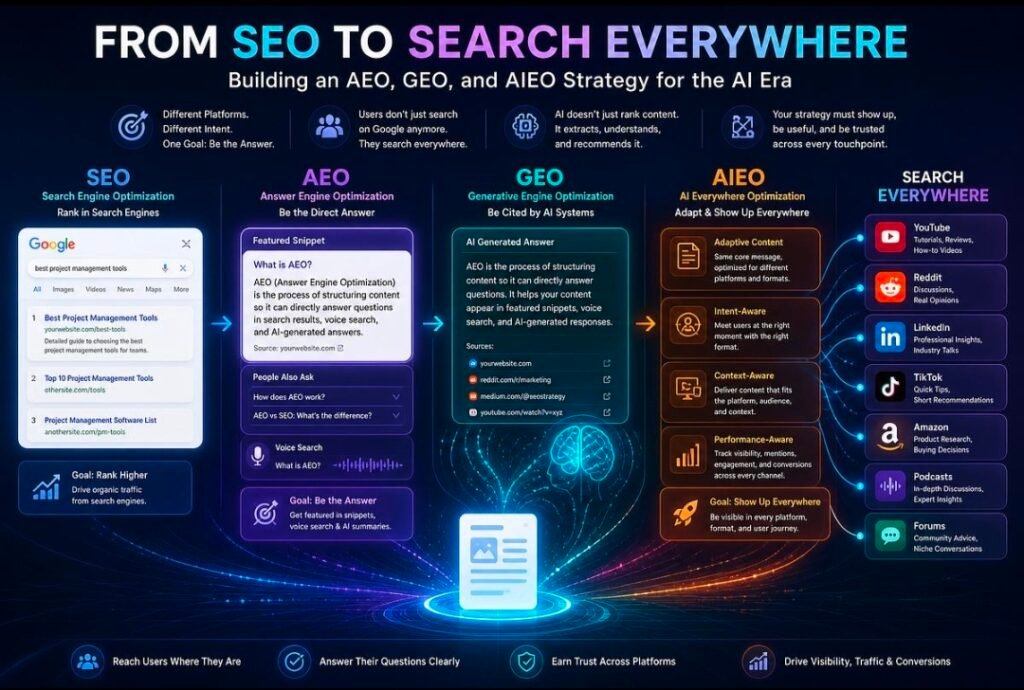
By 2026, marketers are juggling five overlapping disciplines: AEO (Answer Engine Optimisation), GEO (Generative Engine Optimisation), LLMO (Large Language Model Optimisation), AI SEO, and Google’s traditional search ranking factors. Rather than treating these as five separate campaigns, here is a single practical framework — the AGLAG Stack — that covers all five with one set of actions.
| Layer | What It Targets | Core Action |
|---|---|---|
| Foundation (SEO) | Google’s traditional ranking algorithm | Technical health, crawlability, backlinks, page experience |
| Answer Layer (AEO) | Featured snippets, AI Overviews, voice answers | Lead each section with a direct 40–60 word answer before elaborating |
| Generative Layer (GEO) | ChatGPT, Perplexity, Google AI Mode citations | Quotable stats with named sources, clear entity definitions, structured data |
| Model Layer (LLMO) | How LLMs describe your brand from training data | Consistent entity signals across Wikipedia, Reddit, YouTube, review sites |
| AI SEO Layer | Cross-platform AI discovery (chat assistants, in-app search) | llms.txt file, FAQ/HowTo schema, unblocked AI crawlers in robots.txt |
Step-by-Step Implementation Guide
- Audit your AI visibility first. Ask ChatGPT, Gemini, and Perplexity the questions your customers would ask. Note which competitors get cited and which sources they pull from.
- Fix technical access. Confirm AI crawlers aren’t blocked in robots.txt or by CDN bot-protection (a common, invisible problem on Cloudflare-protected sites).
- Restructure your top existing pages before writing new content — add direct-answer summaries, clear H2/H3 hierarchies, and one topic per section.
- Add schema markup for FAQs, HowTo steps, and product/review data.
- Strengthen off-site entity signals — Reddit threads, YouTube mentions, and Wikipedia/Wikidata links carry significant weight with LLMs.
- Publish quotable statistics with named sources — AI engines are far more likely to cite content that includes attributed data than unsourced claims.
- Track citations, not just clicks. Referral traffic from AI is still small in absolute terms, so treat brand mentions and citation frequency as a core KPI, not just visits.
Frequently Asked Questions
What is the biggest digital marketing trend for 2026?
The most consequential shift is the move from traditional keyword-based search to AI-generated answers. Brands now need to be cited inside AI responses, not just ranked on a results page.
Is GEO different from SEO?
They overlap heavily. SEO earns rankings for clicks; GEO earns citation inside AI-generated answers. Strong technical SEO remains the foundation both are built on.
Do I need a separate strategy for ChatGPT, Perplexity, and Google AI Overviews?
Not entirely separate — but each platform weighs sources differently. A single well-structured, well-sourced page can win a Google ranking, an AI Overview citation, and a Perplexity mention at the same time.
Why is nostalgia marketing working so well right now?
Reinterpreted nostalgia signals cultural relevance without requiring audiences to learn something new, which is why campaigns that “remix” familiar IP tend to outperform campaigns built on entirely new concepts.
How should small businesses prioritise limited marketing budgets in 2026?
Start with technical SEO fundamentals, then layer in AEO-style direct answers and FAQ schema — this single investment supports traditional search, AI Overviews, and chatbot citations simultaneously Digital Marketing Trends 2026.
Sources referenced: Google Think with Google (2026 consumer insights), EMARKETER, Search Engine Land, Conductor State of AEO/GEO 2026, Pew Research Center, Ahrefs, and Statcounter GlobalStats Digital Marketing Trends 2026.
AI Replacing Jobs: The Future of Work in 2026 and Beyond
Sources: